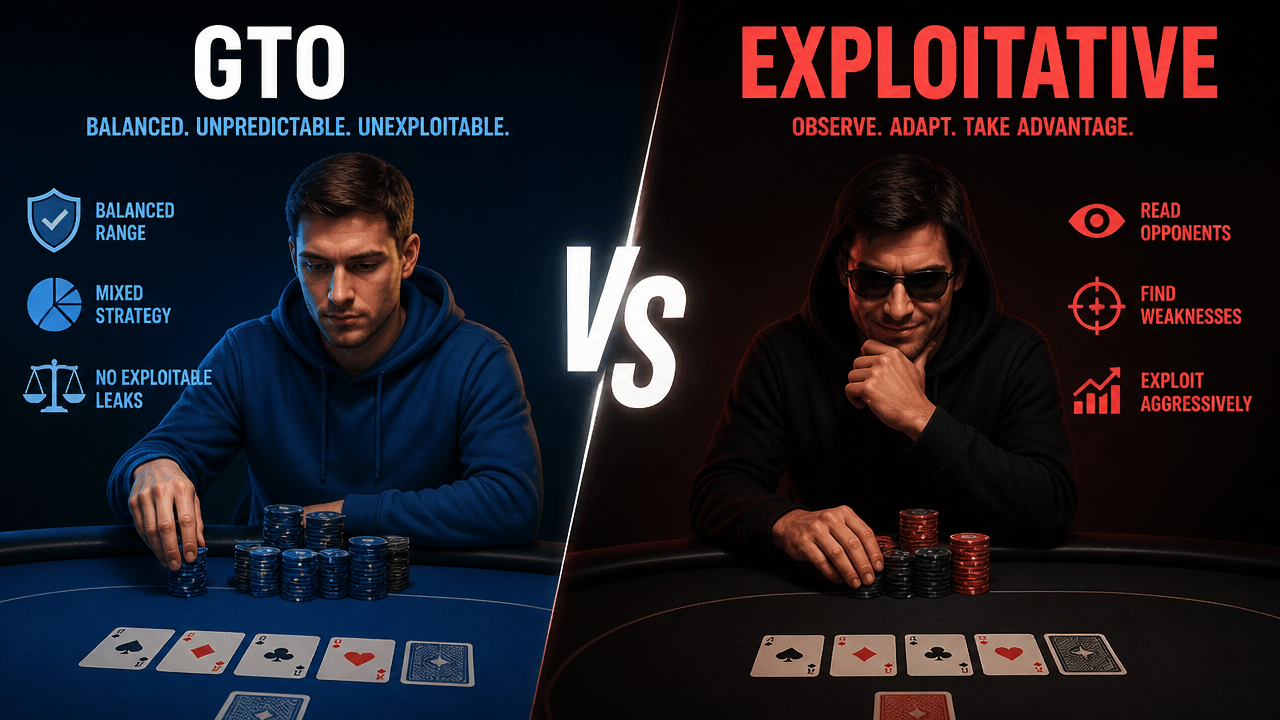
GTO vs Exploitative Play — Which Should You Study First?
The eternal poker debate: should you learn GTO or exploitative strategy first? We break down both approaches and tell you which one will improve your win rate faster.
The Great Debate in Modern Poker
Walk into any poker forum and you'll find the same argument playing out over and over: should you study Game Theory Optimal (GTO) strategy or focus on exploitative play? The answer isn't as simple as picking one side.
What Is GTO Poker?
GTO stands for Game Theory Optimal. It's a mathematically balanced strategy that, when executed perfectly, cannot be exploited by any opponent. Think of it as the "default" — the strategy you'd use if you had zero information about your opponent.
Key characteristics of GTO play:
Balanced ranges. You bet with a mix of strong hands and bluffs in theoretically correct proportions. Your opponent can't profitably adjust because every action you take is balanced.
Frequency-based decisions. Instead of asking "what does my opponent have?" you ask "what's the correct frequency of betting, checking, and raising with my exact hand?"
Solver-derived. GTO strategies come from computer solvers like PioSolver and MonkerSolver that calculate equilibrium solutions for specific situations.
What Is Exploitative Play?
Exploitative strategy means deviating from the balanced approach to take advantage of a specific opponent's mistakes. If a player folds too much to river bets, you bluff them more. If someone never folds top pair, you stop bluffing and value bet thinner.
Key characteristics of exploitative play:
Opponent-dependent. Your decisions change based on who you're playing against. The same hand might be a bet against one player and a check against another.
Reads-based. You need to identify your opponent's tendencies through observation, HUD stats, or physical tells.
Higher variance. When your reads are right, you win more than GTO. When they're wrong, you lose more.
Which Should You Learn First?
If you play online poker: Start with GTO foundations. Online opponents are generally tougher, and you face a rotating cast of players. Building a solid GTO baseline means you'll never be massively exploited, and you can layer exploitative adjustments on top as you gather data.
If you play live poker: Lean toward exploitative strategy. Live games are softer, opponents are more predictable, and you have access to physical tells. A pure GTO approach at a $1/$2 live game is like bringing a Formula 1 car to a go-kart track — impressive but unnecessary.
If you're a complete beginner: GTO first, no question. You need to understand what "correct" looks like before you can identify when opponents deviate from it.
The Real Answer: You Need Both
The best players in the world don't pick sides. They use GTO as their foundation and deviate exploitatively when the situation calls for it. Think of GTO as your autopilot — the strategy you default to when you have no reads. Exploitative play is what you switch to when you spot a weakness.
Study GTO to understand: correct bet sizing, range construction, position play, and balanced aggression.
Study exploitative play to learn: opponent profiling, live reads, population tendencies, and game selection.
Recommended Courses
Our catalog includes courses that cover both approaches. For GTO foundations, look at the Upswing and RaiseYourEdge offerings. For exploitative mastery, Zachary Elwood's behavioral course and the live cash game courses are excellent starting points.
The key isn't choosing one approach — it's knowing when to use each one.
Ready to level up your poker game?
Get premium training from top pros at unbeatable prices — instant access, lifetime access.