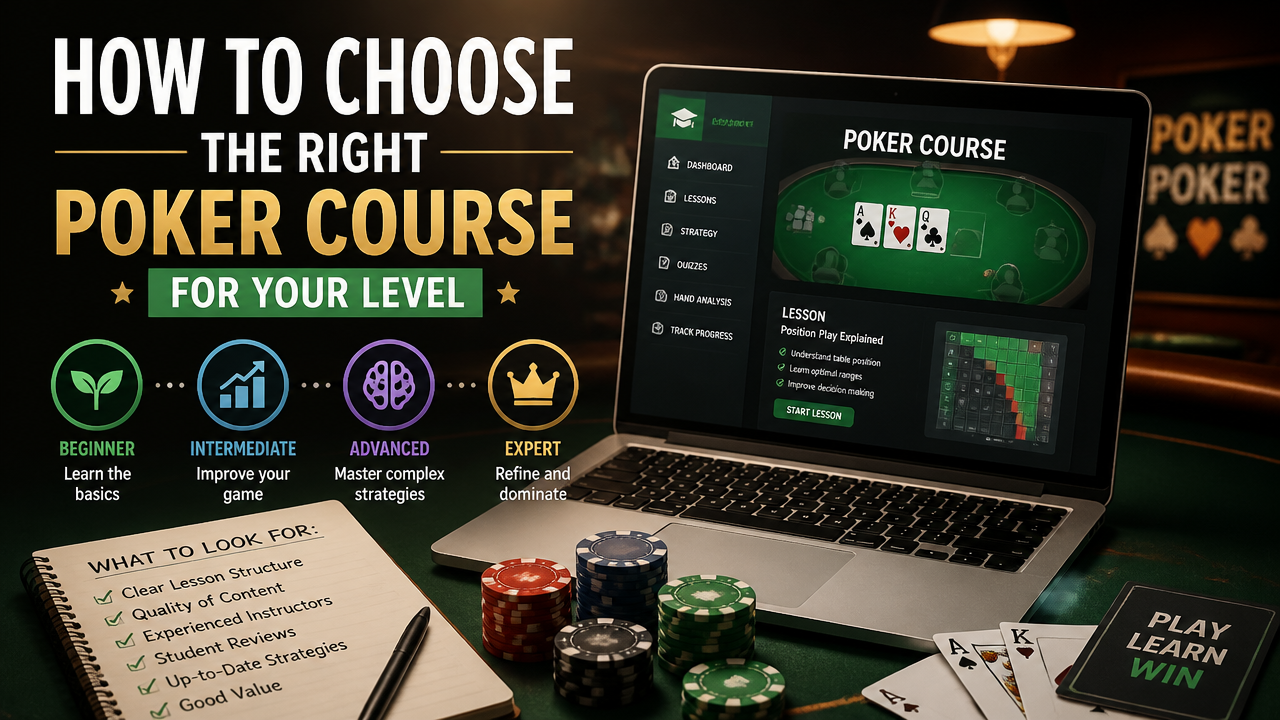
How to Choose the Right Poker Course for Your Level
Not all poker courses are created equal. Learn how to pick the right training program based on your experience level, game format, and learning goals.
Stop Buying Random Poker Courses
The number one mistake aspiring poker players make isn't at the table — it's in the classroom. They buy courses that don't match their level, study material for the wrong format, or jump between coaches without finishing anything.
This guide will help you avoid those pitfalls.
Step 1: Be Honest About Your Level
Beginner (Losing or Break-Even at Micro Stakes)
If you're playing NL2 to NL25 online or $1/$2 live and you're not consistently winning, you're a beginner. There's no shame in this — everyone starts here.
What you need: A course that covers preflop fundamentals, position awareness, basic hand reading, and bankroll management. Avoid anything labeled "advanced" or "solver-based" — it'll confuse more than help.
Recommended content length: 10-20 hours. You need a focused curriculum, not an encyclopedia.
Intermediate (Winning at Low Stakes, Breaking into Mid Stakes)
You're beating NL50 to NL200 or $2/$5 live. You understand the basics but hit walls against better opponents.
What you need: Courses that refine your postflop play, introduce advanced concepts like equity realization, and teach you to exploit common opponent types at your level.
Recommended content length: 20-40 hours. Enough depth to transform your game.
Advanced (Winning at Mid to High Stakes)
You're already profitable but want to maximize your edge. You're familiar with solver concepts and want deeper theoretical understanding.
What you need: Solver-based courses, high-level review sessions, and niche strategy content. At this point, even a 2% improvement in your decision-making translates to significant money.
Recommended content length: 30-50+ hours. The more comprehensive, the better.
Step 2: Match the Format
This seems obvious but is surprisingly common: players buy cash game courses when they primarily play tournaments, or vice versa.
Cash game courses focus on deep-stack play, range construction, exploitative adjustments, and session management. The skills transfer somewhat to tournaments but the emphasis is different.
Tournament courses focus on ICM, stack-size dependent strategy, bubble play, final table dynamics, and push-fold charts. These skills are almost useless in a cash game context.
PLO courses are their own world. If you play Pot Limit Omaha, you need a PLO-specific course. Hold'em courses won't help because the hand values, equity distributions, and bet sizing are fundamentally different.
Step 3: Check the Coach's Credentials
Not all poker coaches are qualified to teach. Here's what to look for:
Verified results. The coach should have a provable track record of winning at stakes higher than what they're teaching. A $1/$2 player teaching a $5/$10 course is a red flag.
Teaching ability. Being a great player and being a great teacher are two different skills. Look for coaches who explain concepts clearly, not just those with the biggest lifetime graph.
Updated content. Poker strategy evolves. A course from 2019 teaches a different game than one from 2025. Check when the content was created or last updated.
Step 4: Consider the Course Structure
The best courses follow a logical progression. They don't just dump 50 hours of hand reviews on you — they build skills methodically.
Look for: A clear curriculum with ordered modules, a mix of theory and practical examples, hand reviews or quizzes to test understanding, and downloadable resources (charts, ranges, cheat sheets).
Avoid: Courses that are just unedited live play recordings, content without any structure or progression, and courses longer than 60 hours with no roadmap.
Step 5: Don't Overspend
This is where StudyCheapCourses comes in. The same courses that retail for $500-$2,500 elsewhere are available on our platform at a fraction of the price. Your education budget should be proportional to the stakes you play — spending $1,000 on a course when your bankroll is $500 doesn't make sense.
Start with one course. Finish it completely. Apply what you learn over 10,000+ hands. Then consider buying the next one.
Ready to level up your poker game?
Get premium training from top pros at unbeatable prices — instant access, lifetime access.