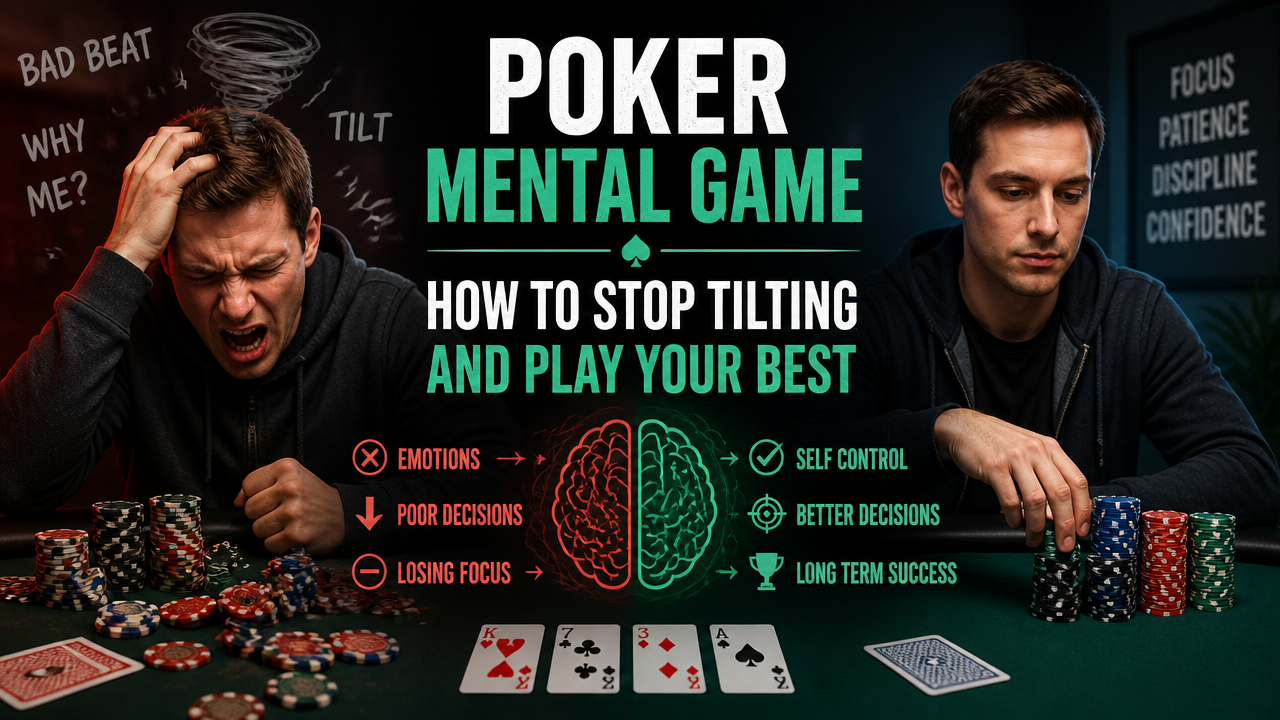
Poker Mental Game — How to Stop Tilting and Play Your Best
Tilt costs poker players more money than any strategic leak. Learn proven techniques to manage emotions, handle bad beats, and perform consistently at the table.
Your Biggest Leak Isn't Strategic — It's Emotional
You've studied preflop ranges. You understand pot odds. You can calculate equity on the fly. But none of that matters when you lose three buy-ins to bad beats and start shoving every hand because you're furious.
Tilt is the single most expensive problem in poker. It's not a bad beat that costs you money — it's the ten hands you play poorly afterward.
What Tilt Actually Is
Tilt isn't just anger. It's any emotional state that causes you to deviate from your best strategy. There are multiple forms:
Anger tilt is the obvious one. You get sucked out on, you slam the table, you start making revenge plays. This is the type most players recognize.
Entitlement tilt happens when you feel you deserve to win. You've played perfectly, the math is on your side, and when you lose you feel the universe owes you. This leads to forcing action in marginal spots.
Fear tilt is the opposite — you become scared of losing. You check when you should bet, fold when you should call, and miss value because you're afraid of another bad outcome.
Despair tilt hits during long downswings. You stop believing your strategy works, start questioning everything, and either quit prematurely or switch to a reckless style trying to "get it back."
The Pre-Session Routine
The best time to handle tilt is before you sit down. Build a pre-session routine that takes 5-10 minutes:
Set a stop-loss. Decide before you play how many buy-ins you're willing to lose. When you hit that number, you quit. No exceptions. No "one more hand." This removes the hardest decision — whether to keep playing — from your tilted brain.
Review your goals. What are you working on this session? Maybe it's 3-bet sizing, or c-bet frequency, or fold-to-river-raises. Having a technical focus keeps your mind analytical instead of emotional.
Check your energy. Are you tired? Hungry? Stressed about something outside poker? These states make you vulnerable to tilt. If you're not at 70%+ energy, the expected value of playing drops significantly.
During the Session
The 10-second rule. After any big pot — win or lose — take 10 seconds before playing the next hand. Close your eyes, take a breath, reset. This tiny pause prevents the emotional carry-over that leads to tilt.
Label your emotions. When you feel frustrated, literally say to yourself: "I'm feeling frustrated." Research in psychology shows that labeling emotions reduces their intensity. It sounds simple because it is. It works because it activates your prefrontal cortex and dampens your amygdala.
Focus on decisions, not results. After every hand, ask one question: "Did I make the best decision with the information I had?" If yes, the result doesn't matter. If no, note the mistake for later review.
Handling Downswings
Downswings are inevitable. Even the best players in the world experience stretches of 20, 50, or even 100 buy-in downswings. What separates winners from quitters is how they handle these periods.
Trust the math. If your strategy is fundamentally sound, variance will correct itself. Pull up your long-term results. Look at the overall trend, not the last three sessions.
Reduce stakes. There's no shame in moving down during a downswing. Playing lower stakes reduces the financial pressure and lets you focus on improving without the stress of significant losses.
Study more, play less. Downswings are the perfect time to invest in education. Review your hands, identify leaks, and work through training material. You'll come back stronger.
Recommended Resources
Our catalog includes several courses that specifically address the mental game of poker. Zachary Elwood's "Beyond Tells" series covers the psychological aspects of reading opponents and managing your own behavior. Several of our advanced courses also include modules on tilt management and performance optimization.
Your mental game is the foundation everything else is built on. Invest in your mind — it's the highest-ROI improvement you can make.
Ready to level up your poker game?
Get premium training from top pros at unbeatable prices — instant access, lifetime access.